Aerial view of a gray outdoor air conditioning condenser unit mounted on a concrete pad next to a house with vinyl siding.

AC Repair in Dover, DE

Tell us about the job

Takes about a minute. No obligation.

RepairCentral ACKent County, DE
Step 1 of 2

What ZIP code is the job in?

Warm air from the vents means the system stopped cooling, not that it's slow

A blower pushing room-temperature or warm air usually points to a refrigerant leak, a failed compressor, or a frozen evaporator coil that's since thawed. This is different from weak airflow, and it almost never fixes itself.

A system that short cycles is wearing out its own parts faster

Turning on and off every few minutes instead of running a full cycle strains the compressor each time it restarts. Left alone, a short-cycling unit tends to fail sooner and harder than one that's just blowing warm.

4 months
June through September, your air conditioner is on duty
85°F
the average summer afternoon it cools against
12 hail events
in ten years, and hail bends the fins on outdoor coils
120 wind events
in ten years, and wind drives debris into outdoor units
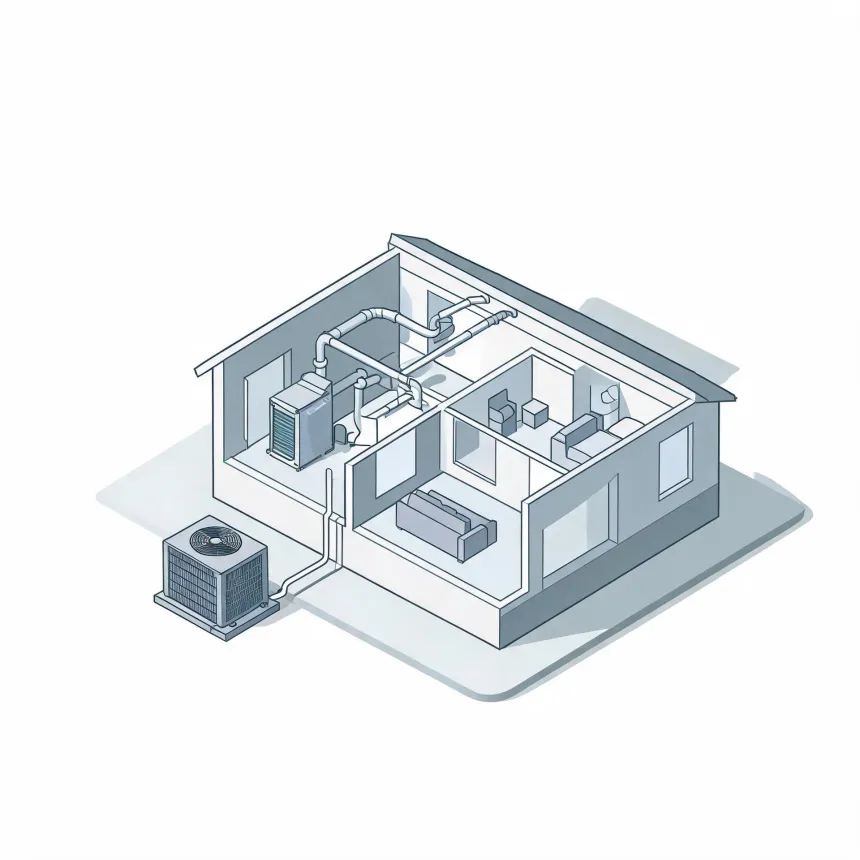
Isometric line illustration of a cutaway house showing interior rooms, a furnace or air handler with ductwork, and an outdoor condenser unit beside the building.
Your air conditioner works hardest from June through August.

NOAA nClimDiv, 1991–2020 normals

Dover summers run four months, June through September, with afternoon highs averaging 85.

A central AC system in Dover that breaks down now is wearing out or losing charge, not losing a fight with the weather.

Dover pays 16.57 cents a kilowatt-hour, and a system running on a bad part pays that rate every hour it's on

Power costs 16.57 cents a kWh statewide
Cooling runs June through September
Summer afternoons average 85°F
A system this young is usually worth fixingHalf the homes in Kent County were built in 1993 or later.

A bad capacitor or a low charge doesn't just stop cooling, it makes the compressor work harder for whatever cooling it still manages. That shows up on the bill before it shows up as a full breakdown. At 16.57 cents a kilowatt-hour, a unit limping along for a few weeks costs real money before it quits for good. Getting a contractor to diagnose the actual part now, rather than waiting to see if it gets worse, is what keeps that cost from compounding.

Get the usual fix

Nothing about this area is especially hard on it. It's most likely the usual problem with the usual fix.

Find a contractor
An outdoor air conditioning condenser unit mounted on a concrete pad surrounded by gravel, photographed against a partly cloudy blue sky.

What actually gives out, and why

Every cycle starts the same way, and that's where the wear happens. The capacitor gives the compressor and fan motor the jolt they need to start, over and over, and that part either weakens slowly or fails outright. The contactor switches the power each time a cycle starts, and its contacts pit a little more with every start until they stick or stop making contact at all. Refrigerant doesn't get consumed by running. If the charge is low, it's because it's leaking out somewhere, a joint, a coil, a fitting, and that leak only gets worse left alone. A dirty condenser coil doesn't fail on its own, but it makes the compressor behind it work harder for the same result, and compressors under that kind of strain don't last as long. None of this is the system losing a fight with the heat. It's the same parts starting and stopping thousands of times until one of them doesn't start cleanly anymore.

A frozen coil spreads the damage

When airflow drops or the charge is low, the evaporator coil ices over. Run the system anyway and liquid refrigerant backs up into the compressor, which is built to pump vapor, not liquid. A compressor that keeps swallowing liquid wears out fast, long before it would have from the coil problem alone.

A failing capacitor takes the motor with it

A weak capacitor makes the compressor or fan motor strain to start instead of kicking on clean. Each hard start heats the motor windings more than a normal one does. Keep running it that way and the motor itself can fail, so a small part left alone can take a much bigger one down with it.

Aerial view of a gray central air conditioning condenser unit on a concrete pad next to a house with vinyl siding.

A new air conditioner would cut about $40 a year off cooling for a typical Kent County home.

  • A new one at the federal minimum, 14.3 SEER2$260 a year
  • An older air conditioner$300 a year

Estimates for a typical Kent County home, compared with an older unit built to the previous federal minimum, from EIA household energy data, Delaware fuel prices and NOAA climate normals. Your home will differ.

Repair makes sense when a part like a capacitor or contactor has failed.

Replacement makes sense when the compressor has failed or the system uses R-22 refrigerant, which is no longer made.

A diagnostic starts with gauges and a meter, not guesses. The contractor checks refrigerant pressure first. That reading points straight at a leak or a failed compressor before anything gets taken apart. Next comes the electrical side, the capacitor, the contactor, the wiring at the disconnect. The contractor is looking for the pitting and weak readings that explain a hard start or a system that won't start at all. If the coil was frozen, it has to thaw fully before any of those readings mean anything, so sometimes the visit includes waiting before it includes testing. The point of walking through it in that order is to find the one part actually responsible, not to replace parts until something works.